



Niagara Falls is more than a scenic wonder; it is a profound natural force that has inspired both awe and audacious human challenge. This article documents the verified history of those who attempted to conquer the Falls, separating triumphant survival from tragic failure. Our account is compiled from historical records, official reports, and documented first-hand testimonies to provide an accurate and authoritative resource on this unique facet of Niagara’s history.
- The Unmatched Power of Niagara Falls
- The Survivors: A Verified Chronology
- Annie Edson Taylor (October 24, 1901)
- Bobby Leach (July 25, 1911)
- Jean Lussier (July 4, 1928)
- Nathan Boya / William Fitzgerald (July 15, 1961)
- Karel Soucek (July 2, 1984)
- Steve Trotter (First Attempt – August 18, 1985)
- John “David” Munday (October 5, 1985 & September 27, 1993)
- Peter De Bernardi & Jeffery James Petkovich (September 28, 1989)
- Steve Trotter & Lori Martin (Second Attempt – June 18, 1995)
- Documented Fatalities: A Solemn Record
- Important Legal and Safety Context
- Conclusion
The Unmatched Power of Niagara Falls
Before recounting these stories, it is critical to understand the formidable opponent these individuals faced. Niagara Falls is not only one of the world’s largest waterfalls but also among the most powerful. The Horseshoe Falls, the site of most stunts, has a vertical drop of approximately 167 feet (51 meters) and a crest line stretching over 2,700 feet (823 meters). Its relentless flow generates immense hydraulic force, with an estimated 2,509 tons of water descending per second at the crest. This context is essential for appreciating the extreme peril of any attempt to go over the brink.
The Survivors: A Verified Chronology
Annie Edson Taylor (October 24, 1901)
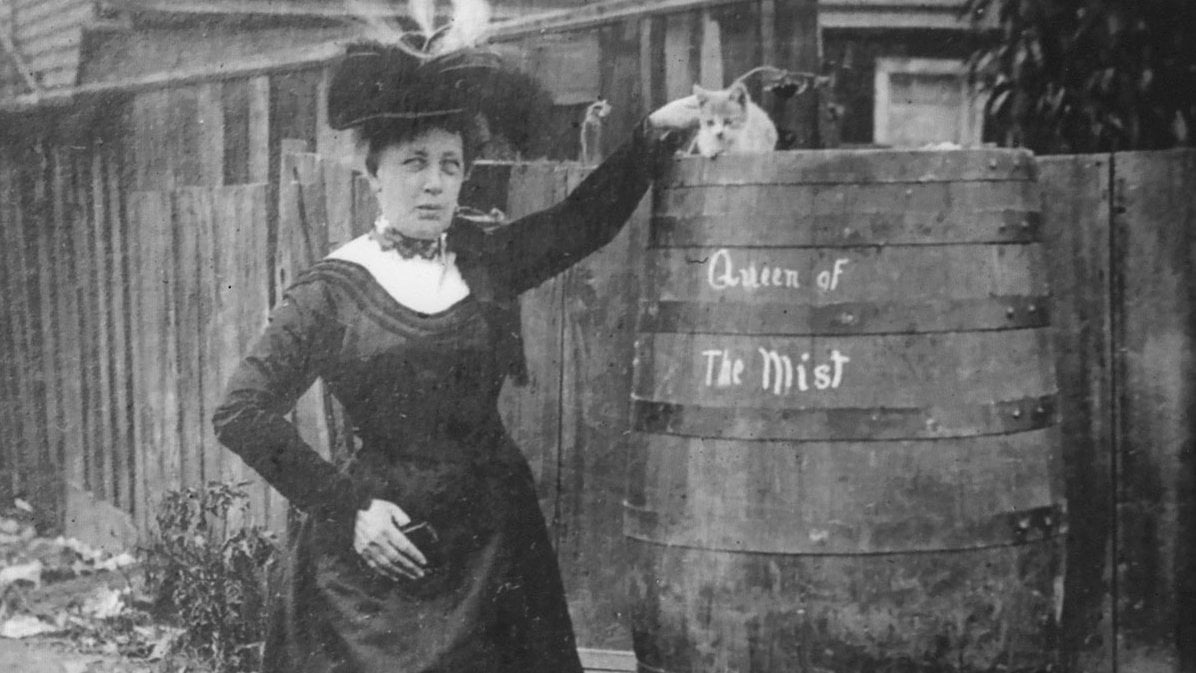
- Factual Background: A 63-year-old widowed schoolteacher from Bay City, Michigan, Taylor became the first person on record to survive the plunge over the Horseshoe Falls in a barrel. Her primary motivation, as reported by contemporary newspapers like The New York Times and her own later statements, was to achieve fame and financial security after years of economic hardship following her husband’s death in the Civil War.
- Engineering & Preparation: She commissioned a custom-made barrel of white oak and iron, measuring 4.5 feet high and 3 feet in diameter. It was padded with a mattress and secured internally with a leather harness to hold her in place. To test its buoyancy and integrity, she first sent the barrel over the Falls with a domestic cat named Iagara inside; the cat survived, leading Taylor to proceed.
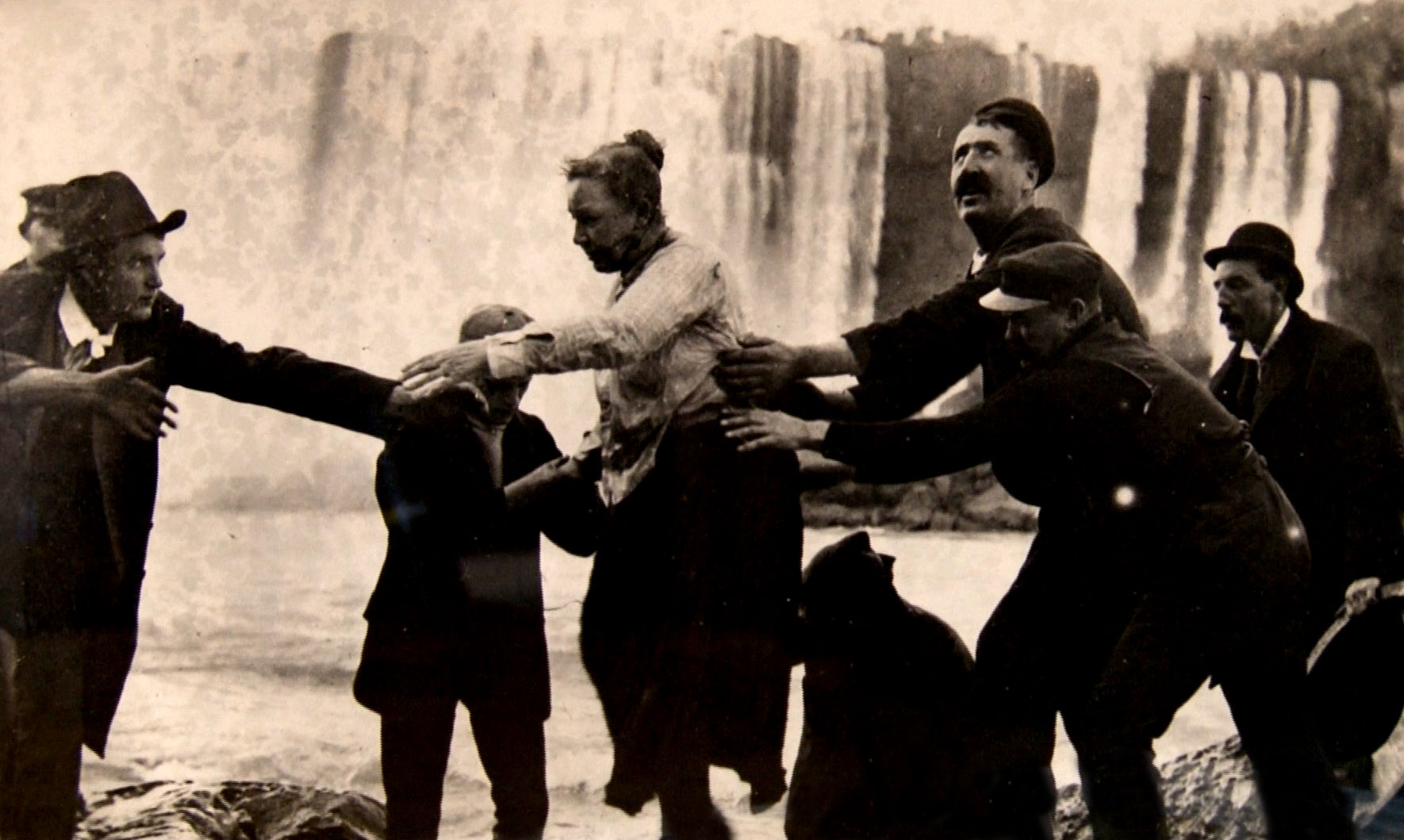
- The Stunt & Aftermath: After being set adrift from a rowboat, she went over the Falls and was retrieved by rescuers 17 minutes later, alive and conscious with only a minor cut on her head. Her initial success was widely sensationalized in the press.
- Verified Quote & Legacy: Historical press accounts, including interviews in The Buffalo Evening News, quote her sobering warning: “If it was with my dying breath, I would caution anyone against attempting the feat … I would sooner walk up to the mouth of a cannon, knowing it was going to blow me to pieces than make another trip over the Fall.” Despite surviving, she was unable to monetize her fame effectively, spending her later years in poverty. She died in 1921 at age 82.
Bobby Leach (July 25, 1911)
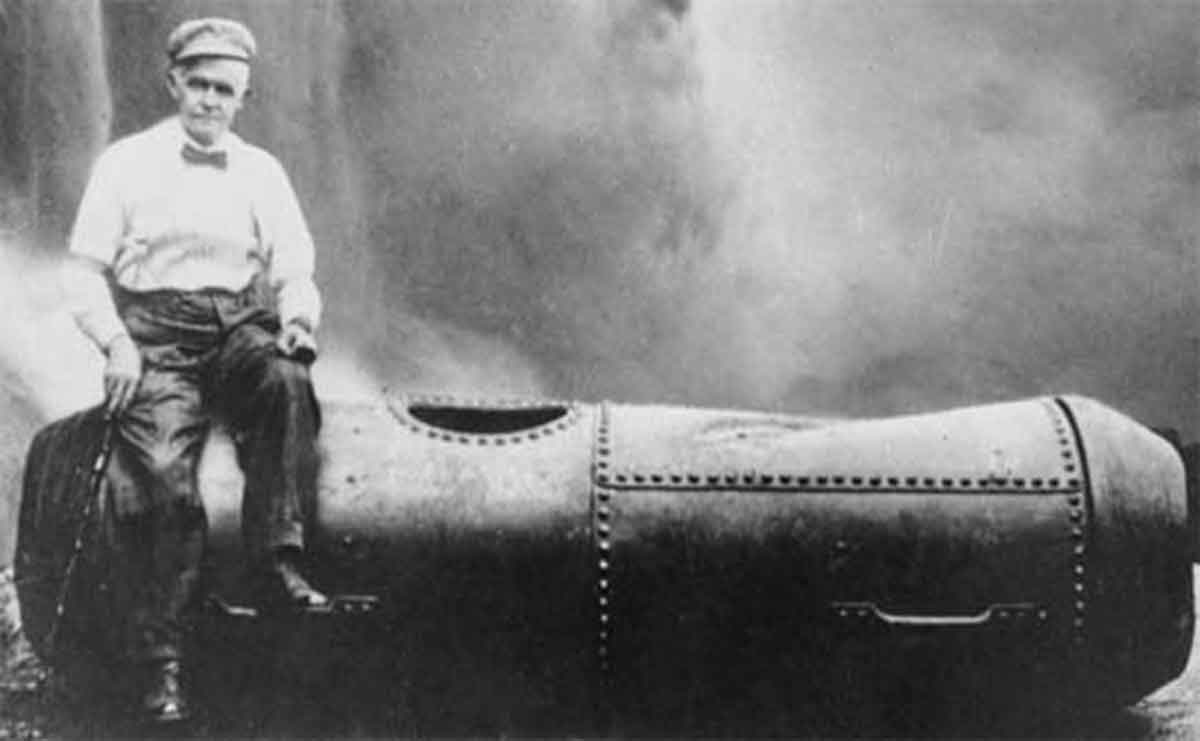
- Factual Background: An English-born professional performer and expert swimmer, Leach was a veteran of Barnum & Bailey’s circus. Seeking to outdo Annie Taylor, he designed a purpose-built steel barrel, cylindrical in shape and heavily riveted.
- The Stunt & Severe Injuries: Unlike Taylor’s wooden cask, Leach’s steel barrel was not padded. After his successful plunge, he was trapped inside the battered barrel for over two hours before being extracted. Documented hospital records from Greater Niagara General Hospital confirm he suffered catastrophic injuries, including two broken kneecaps, a fractured jaw, and several broken ribs, requiring a six-month hospitalization—a stark testament to the violence of the descent.
- Outcome & Ironic Death: Leach toured for years, capitalizing on his survival. His death in 1926, however, became a widely reported macabre footnote: he slipped on an orange peel in New Zealand, developed gangrene in his leg, and died following an amputation, underscoring the unpredictable nature of fate.
Jean Lussier (July 4, 1928)
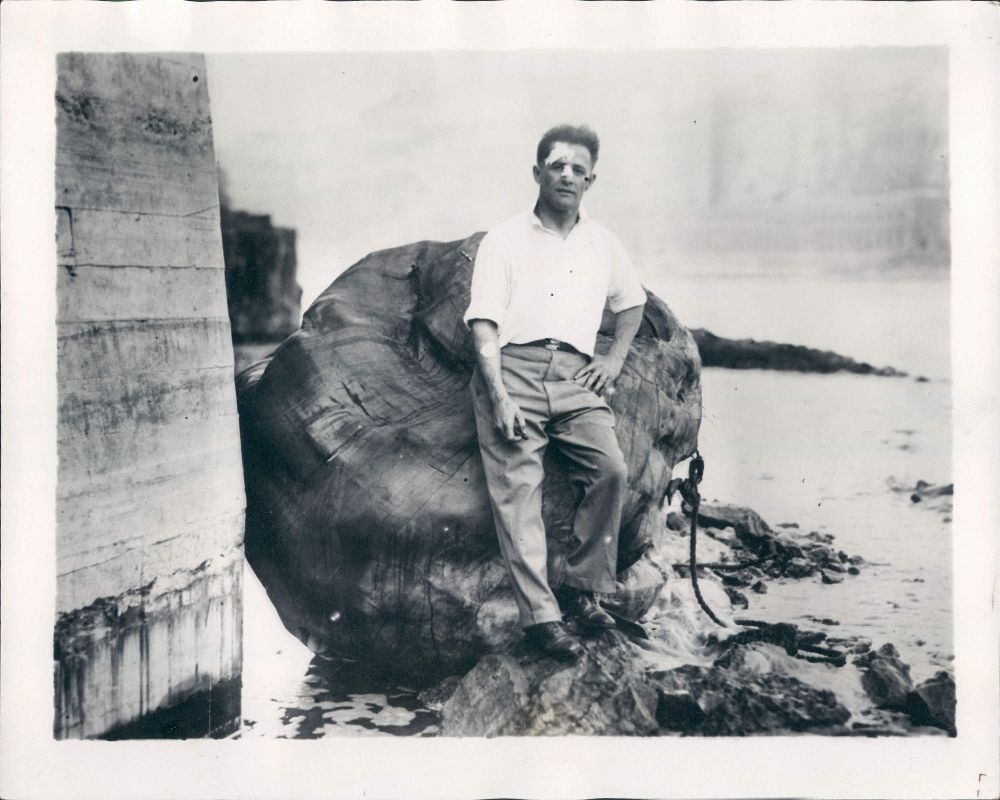
- Factual Background: A French-Canadian machinist and factory worker from Springfield, Massachusetts, Lussier approached the challenge as an engineering problem. He rejected the standard barrel design in favor of a spherical vessel to distribute impact forces more evenly.
- Engineering Innovation: His craft was a revolutionary six-foot rubber ball consisting of a steel framework encased in thick rubber and lined with 32 separate inner tubes for cushioning. The interior featured a central 150-pound rubber ballast to prevent tumbling and was equipped with an oxygen supply, pressure gauges, and valves designed to sustain life for up to 40 hours—a significant advancement in safety planning.
- The Stunt & Outcome: Lussier’s meticulous preparation paid off. He emerged from his innovative ball with only a minor cut on his forehead. He later sold pieces of the inner tubes as souvenirs. He lived to the age of 80, dying of natural causes in 1971.
Nathan Boya / William Fitzgerald (July 15, 1961)

- Factual Background: A 35-year-old Bronx native and Korean War veteran, Boya undertook his stunt under the name William Fitzgerald. His motivation, as he later revealed in a definitive National Geographic documentary interview, was deeply personal: a form of self-punishment after breaking off an engagement to a woman he felt he had wronged. They had planned to honeymoon at Niagara Falls.
- The Vessel & Legal Precedent: He constructed a 1,250-pound rubber sphere over a steel frame, which he called the “Plunge-O-Sphere.” His attempt occurred a decade after the death of William “Red” Hill, Jr., which had prompted a formal crackdown. Official Niagara Parks Police records confirm Boya was the first person arrested and prosecuted under these new regulations. He was fined $113.60 for “stunting without a permit.”
- The Stunt: After being spotted in the river, his sphere was retrieved by Captain Lawrence McGinn of the Maid of the Mist. Boya survived with only bruises on his back, cementing the paradox of surviving the Falls only to be met by law enforcement.
Karel Soucek (July 2, 1984)

- Factual Background: A 37-year-old professional stuntman from Hamilton, Ontario, Soucek was a seasoned daredevil. He famously painted the phrase “Last of the Niagara Daredevils” on the side of his homemade red-and-white barrel—a claim that would prove historically inaccurate.
- Engineering & Stunt: His barrel was a lightweight capsule constructed of aluminum, steel, and plastic. It featured a critical 800-pound steel weight attached to one end to ensure it went over the Falls foot-first, minimizing tumbling. This design was largely successful.
- Legal Action & Tragic Outcome: He survived with only a cut on his forehead. As documented in court records, he was fined $500 and his barrel was confiscated. Soucek died less than a year later, on January 20, 1985, during a paid stunt at the Houston Astrodome, where a barrel drop from the roof into a water tank went fatally wrong. His death was front-page news, serving as a grim reminder of the perpetual risks of the profession.
Steve Trotter (First Attempt – August 18, 1985)

- Factual Background: At age 22, Steve Trotter became the youngest person on record to survive the plunge over the Horseshoe Falls.
- The Stunt: His craft, nicknamed “the Rig,” was constructed from two industrial pickle barrels reinforced with fiberglass, balsa wood, and surrounded by truck tire inner tubes for shock absorption. He was secured inside with a racing harness and equipped with oxygen tanks and a two-way radio, as documented in subsequent court evidence.
- Outcome & Legal Action: Trotter emerged unharmed, swam free, and was picked up by the Maid of the Mist crew. Official Niagara Parks Police records confirm he was charged and fined $500 for violating the Niagara Parks Act.
John “David” Munday (October 5, 1985 & September 27, 1993)

- Factual Background: David Munday, a skydiving instructor from Milton, Ontario, became the first person to survive the plunge over the Horseshoe Falls twice, as verified by Niagara Parks Police reports.
- First Stunt (1985): For his initial attempt, Munday designed a capsule made from a modified 10-gauge steel boiler tank, which he named the “Jet Stream.” He emphasized his experience with risk, stating to the press that parachuting was statistically more dangerous. He emerged with only bruises.
- Second Stunt (1993) & Legal Escalation: His second, nearly identical attempt eight years later solidified his unique record. However, it resulted in a dramatic increase in legal penalties as authorities sought to deter copycats. He was fined approximately $12,000 CAD, a stark escalation from previous fines.
- Documented Mindset: In media interviews, Munday consistently framed his feats as personal challenges of preparation and engineering, downplaying the role of luck. He cited his meticulous planning and the capsule’s design as the keys to his survival.
Peter De Bernardi & Jeffery James Petkovich (September 28, 1989)

- Factual Background: Peter De Bernardi, a 42-year-old from Niagara Falls, Ontario, and Jeffery Petkovich, a 25-year-old university student from Michigan, became the first duo to survive the plunge together in a single vessel.
- The Vessel & Stated Purpose: De Bernardi constructed a massive, 12-foot-long, 3,000-pound steel barrel. Painted on its side was the message “Don’t put yourself on the Edge – Drugs will kill you,” as documented in police evidence photos. They publicly stated the stunt was to promote an anti-drug campaign, garnering significant pre-stunt media attention.
- The Stunt: The two men rode head-to-head inside the barrel, secured by harnesses and using shared oxygen tanks. After the plunge, they were recovered with only minor injuries.
- Legal Action & Precedent: Both refused medical care and were immediately arrested. They were each fined $1,500 CAD under the Niagara Parks Act. Their highly publicized stunt and the perceived exploitation of a social cause for an illegal act directly influenced the Niagara Parks Commission to raise the maximum fine to $10,000 CAD shortly thereafter, setting a new legal precedent for punishment.
Steve Trotter & Lori Martin (Second Attempt – June 18, 1995)

- Factual Background: A decade after his first success, Steve Trotter, now 32, intentionally became the second person to survive the plunge twice. He was joined by 29-year-old Lori Martin, making them the second successful duo.
- The Stunt & Rescue: Their craft was a 12-foot barrel made from welded water heaters, coated in Kevlar and thick Styrofoam. After going over the Falls, the barrel became dangerously lodged in a rock crevice. A multi-agency emergency response involving the Niagara Parks Police and Niagara Falls Fire Department was required to secure the barrel and extract the pair, as reported in fire department logs and contemporary news coverage.
- Outcome & Legal Action: Both sustained only minor injuries. They were immediately arrested upon rescue. The barrel remained a hazard in the river for over a week before a crane could retrieve it. Both faced significant legal penalties for their illegal stunt.
Documented Fatalities: A Solemn Record
For every survivor, others have met tragedy. This list is compiled from coroner’s reports, police records, and verified news accounts:
- Charles Stephens (July 11, 1920): Perished in a barrel; only an arm strap was recovered.
- George Stathakis (July 4, 1930): Died in a barrel; his turtle survived.
- William “Red” Hill, Jr. (August 5, 1951): Killed in a complex craft dubbed “The Thing.”
- Jesse Sharp (June 5, 1990): Attempted in a canoe without a life jacket; his body was never recovered.
- Robert Overacker (October 1, 1995): Used a jet ski with a rocket-deployed parachute that failed; his death was recorded on live television.
- Kirk Jones (April 19, 2017): Survived a 2003 plunge with no protection (and was fined) but died in a subsequent attempt in an inflatable ball.
Important Legal and Safety Context
These stunts are illegal. Under the Niagara Parks Act, attempting to go over the Falls is a prosecutable offense that can result in severe fines (up to $25,000 CAD) and potential imprisonment. The Niagara Parks Police Service vigorously enforces this law to prevent loss of life and the endangerment of rescue personnel.
Conclusion
The history of Niagara Falls daredevils is a stark record of human ambition versus natural force. While the stories of survivors like Annie Taylor are part of the Falls’ lore, they are overshadowed by the legal consequences, severe injuries, and documented fatalities. This article serves as an authoritative reference on the subject, emphasizing that the true awe of Niagara Falls is best appreciated from the safety of its surrounding parks and observation points.